
Sentinels and Concepts with Ranges Algorithms
The ranges library in C++20 supports sentinels. Sentinels stand for the end of a range and can be regarded as generalized end iterators.
A range provided by a begin iterator and an end sentinel specifies a group of items you can iterate over. The containers of the STL are ranges because their end iterator marks the end of the range.
Sentinel
std::vector<int>.// sentinel.cpp #include <iostream> #include <algorithm> #include <compare> #include <vector> struct Space { // (1) bool operator== (auto pos) const { return *pos == ' '; } }; struct NegativeNumber { // (2) bool operator== (auto num) const { return *num < 0; } }; struct Sum { // (7) void operator()(auto n) { sum += n; } int sum{0}; }; int main() { std::cout << '\n'; const char* rainerGrimm = "Rainer Grimm"; std::ranges::for_each(rainerGrimm, Space{}, [] (char c) { std::cout << c; }); // (3) std::cout << '\n'; for (auto c: std::ranges::subrange{rainerGrimm, Space{}}) std::cout << c; // (4) std::cout << '\n'; std::ranges::subrange rainer{rainerGrimm, Space{}}; // (5) std::ranges::for_each(rainer, [] (char c) { std::cout << c << ' '; }); // (6) std::cout << '\n'; for (auto c: rainer) std::cout << c << ' '; std::cout << '\n'; std::cout << "\n"; std::vector<int> myVec{5, 10, 33, -5, 10}; for (auto v: myVec) std::cout << v << " "; std::cout << '\n'; auto [tmp1, sum] = std::ranges::for_each(myVec, Sum{}); std::cout << "Sum: " << sum.sum << '\n'; // (8) auto [tmp2, sum2] = std::ranges::for_each(std::begin(myVec), NegativeNumber{}, Sum{} ); std::cout << "Sum: " << sum2.sum << '\n'; // (9) std::ranges::transform(std::begin(myVec), NegativeNumber{}, // (10) std::begin(myVec), [](auto num) { return num * num; }); std::ranges::for_each(std::begin(myVec), NegativeNumber{}, // (11) [](int num) { std::cout << num << " "; }); std::cout << '\n'; for (auto v: std::ranges::subrange{ std::begin(myVec), NegativeNumber{}}) { // (12) std::cout << v << " "; } std::cout << "\n\n"; }
NegativeNumber (line 2). Both define the equal operator. Thanks to the <compare> header, the compiler auto-generates the non-equal operator. The non-equal operator is required when using algorithms such as std::ranges_for_each or std::ranges::transform with a sentinel. Let me start with the sentinel Space.Space{} directly onto the string “rainerGrimm“. Creating a std::ranges::subrange (line 4) allows it to use the sentinel in a range-based for-loop. You can also define a std::ranges::subrange and use it directly in the algorithm std::ranges::for_each (line 5) or in a range-based for-loop (line 6).std::vector<int>, filled with the values {5, 10, 33, -5, 10}. The sentinel NegativeNumber checks if a number is negative. First, I sum up all values using the function object Sum (line 7). std::ranges::for_each returns a pair (it, func). it is the successor of the sentinel and func the function object applied to the range. Thanks to the structured binding, I can directly define the variables sum and sum2 and display their values (lines 8 and 9). std::ranges::for_each uses the sentinel NegativeNumber. Consequently, sum2 has the sum up to the sentinel. The call std::ranges::transform (line 10) transforms each element to its square: [](auto num){ return num * num}. The transformation stops with the sentinel NegativeNumber. Line 11 and line 12 display the transformed values.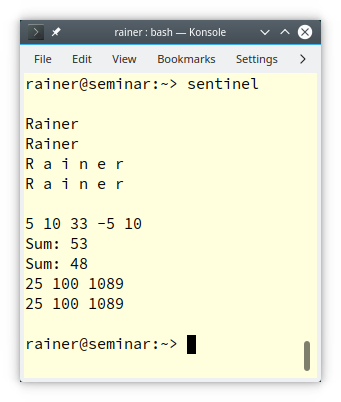
You may ask yourself, should I use a classical algorithm of the STL or the ranges pendant on a container? Let me answer this question by comparing both.
std Algorithms versus std::ranges Algorithms
Before I dive into the details in my comparison, I want to provide the big picture:
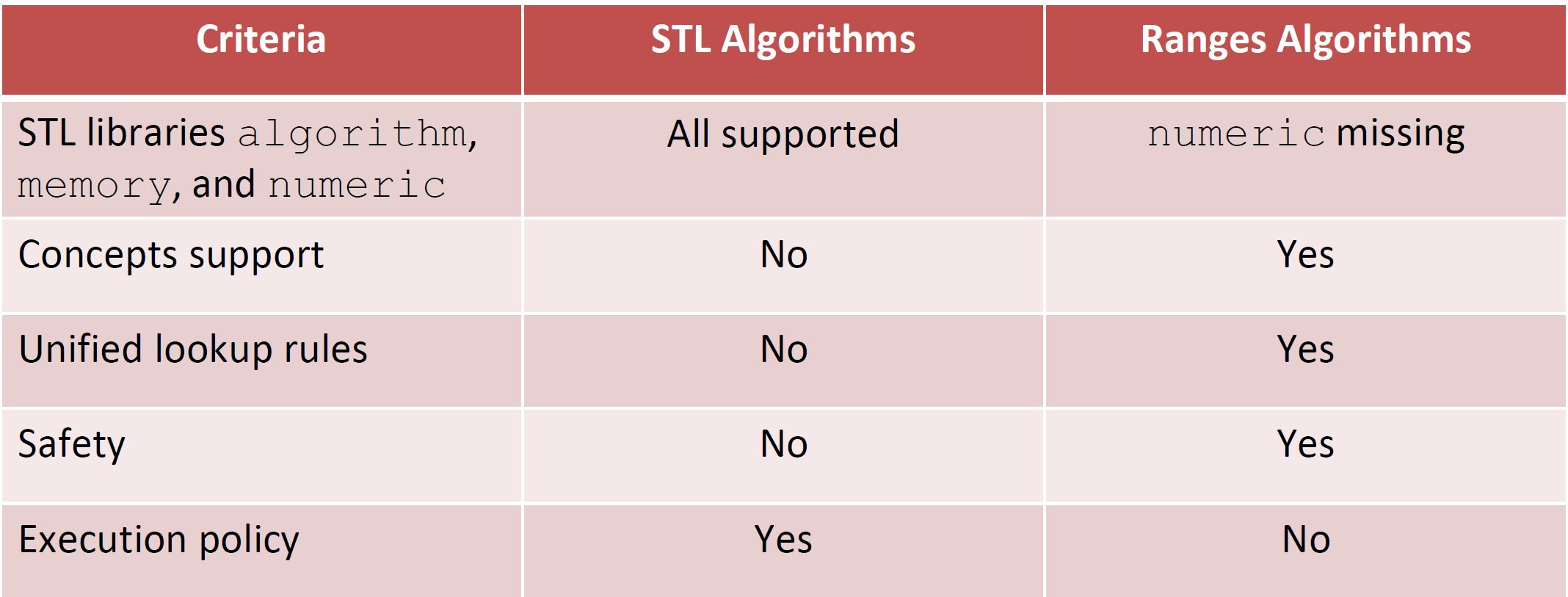
Range does not support numeric
The ranges does support the functions of the functional, and the algorithm header, but the function of the numeric header. The mathematical functions such as numeric header includes std::gcd, std::midpoint, std::iota, or std::accumulate.
Let me write about more interesting differences.
Concept support
The std::ranges algorithms are the poster child for concepts.
std::sort and the new std::ranges::sort. std::sort and std::ranges::sort require a random-access iterator that can access each range element in constant time. Here are the two relevant overloads for std::sort and std::ranges::sort.std::sort
template< class RandomIt >
constexpr void sort( RandomIt first, RandomIt last );
std:ranges::sort
template <std::random_access_iterator I, std::sentinel_for<I> S,
         class Comp = ranges::less, class Proj = std::identity>
requires std::sortable<I, Comp, Proj>
constexpr I sort(I first, S last, Comp comp = {}, Proj proj = {});
std::sort or std::ranges::sort with a container such as std::list only supporting a bidirectional iterator?std::sort
// sortVector.cpp

#include <algorithm>
#include <list>

int main() {

   std::list<int> myList{1, -5, 10, 20, 0};
   std::sort(myList.begin(), myList.end());

}
sortVector.cpp with the GCC causes an epic error message of 1090 lines.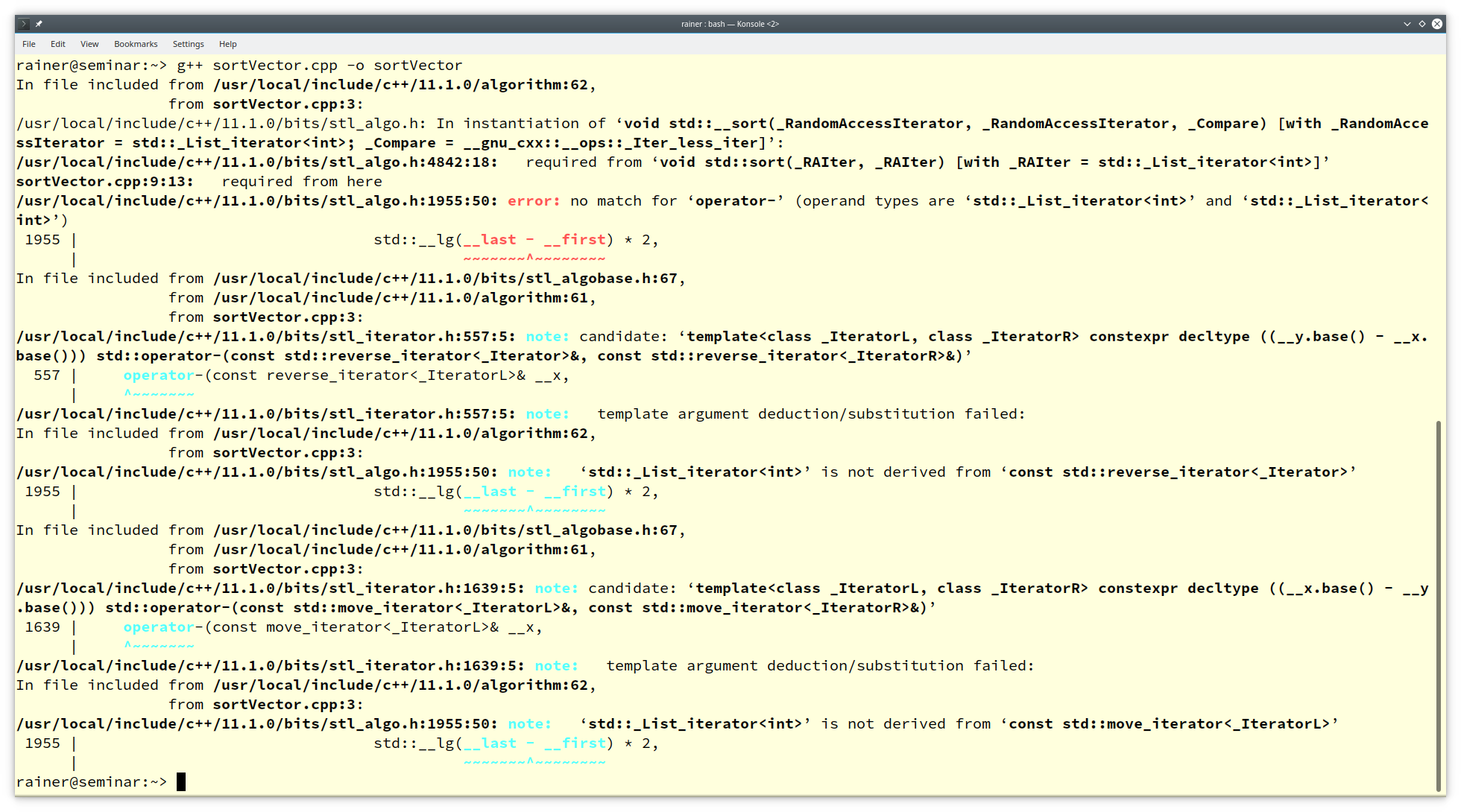
std::ranges::sort
// sortRangesVector.cpp

#include <algorithm>
#include <list>

int main() {

   std::list<int> myList{1, -5, 10, 20, 0};
   std::ranges::sort(myList.begin(), myList.end());

}
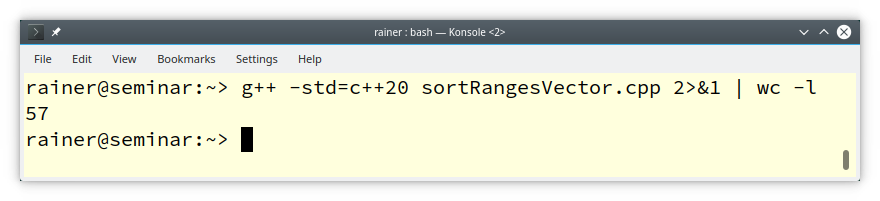
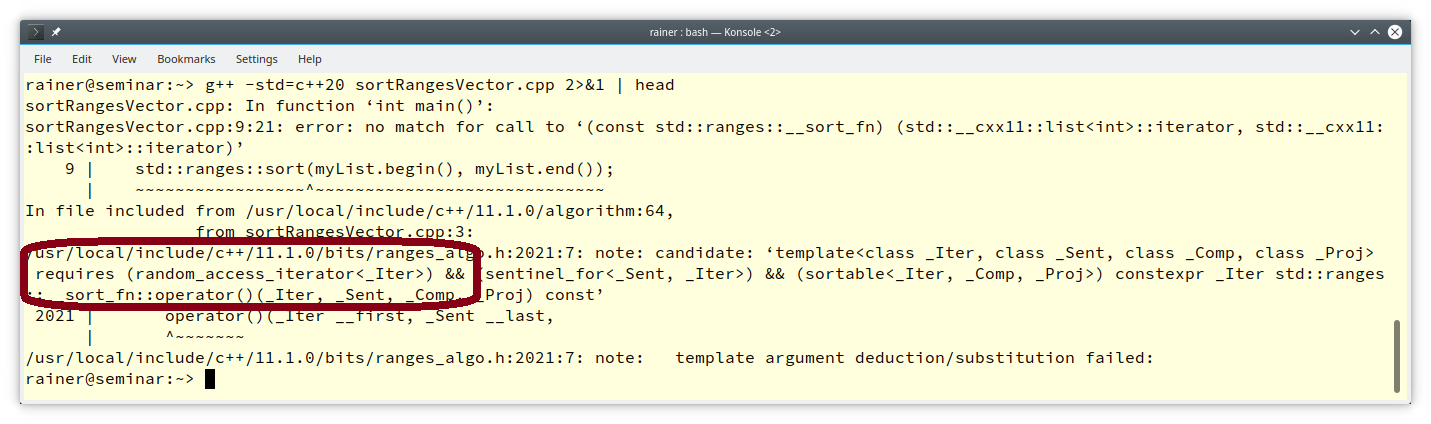
Using std::ranges::sort instead of std::sort reduces the error message drastically. Now, I get 57 error lines.
Which mentoring program should I implement next?
I’m happy that the current mentoring program, “Fundamentals for C++ Professionals”, is a big success and has more than 35 participants. Now, I will implement an additional mentoring program. All of them are based on my C++ books, posts, and classes.
Make your choice here: https://www.modernescpp.com/index.php/my-next-mentoring-program
What’s next?
I’m not done with my comparison of std and std::ranges algorithms. In my next post, I will write about the unified lookup rules that std::ranges algorithms provide and additional safety guarantees.
Thanks a lot to my Patreon Supporters: Matt Braun, Roman Postanciuc, Tobias Zindl, G Prvulovic, Reinhold Dröge, Abernitzke, Frank Grimm, Sakib, Broeserl, António Pina, Sergey Agafyin, Андрей Бурмистров, Jake, GS, Lawton Shoemake, Jozo Leko, John Breland, Venkat Nandam, Jose Francisco, Douglas Tinkham, Kuchlong Kuchlong, Robert Blanch, Truels Wissneth, Mario Luoni, Friedrich Huber, lennonli, Pramod Tikare Muralidhara, Peter Ware, Daniel Hufschläger, Alessandro Pezzato, Bob Perry, Satish Vangipuram, Andi Ireland, Richard Ohnemus, Michael Dunsky, Leo Goodstadt, John Wiederhirn, Yacob Cohen-Arazi, Florian Tischler, Robin Furness, Michael Young, Holger Detering, Bernd Mühlhaus, Stephen Kelley, Kyle Dean, Tusar Palauri, Juan Dent, George Liao, Daniel Ceperley, Jon T Hess, Stephen Totten, Wolfgang Fütterer, Matthias Grün, Ben Atakora, Ann Shatoff, Rob North, Bhavith C Achar, Marco Parri Empoli, Philipp Lenk, Charles-Jianye Chen, Keith Jeffery, Matt Godbolt, Honey Sukesan, bruce_lee_wayne, Silviu Ardelean, schnapper79, Seeker, and Sundareswaran Senthilvel.
Thanks, in particular, to Jon Hess, Lakshman, Christian Wittenhorst, Sherhy Pyton, Dendi Suhubdy, Sudhakar Belagurusamy, Richard Sargeant, Rusty Fleming, John Nebel, Mipko, Alicja Kaminska, Slavko Radman, and David Poole.
| My special thanks to Embarcadero |  |
| My special thanks to PVS-Studio |  |
| My special thanks to Tipi.build |  |
| My special thanks to Take Up Code |  |
| My special thanks to SHAVEDYAKS |  |
Modernes C++ GmbH
Modernes C++ Mentoring (English)
Beatrix Jaud-Grimm
Kelterstraße 23
72108 Rottenburg
Mail: schulung@ModernesCpp.de
Mentoring: www.ModernesCpp.org

 Modernes C++ Mentoring
Do you want to stay informed: Subscribe.




Leave a Reply
Want to join the discussion?Feel free to contribute!